News & Blog
How to Spot a Counterfeit Coin
Every collector, sooner or later, holds a coin that makes them pause. Something about it is faintly wrong — the weight, the shine, a softness in the details — and the question arrives unbidden: is this real? Counterfeiting is as old as coinage itself, and it has never been more active than it is today. Learning to answer that question is not paranoia; it is one of the core skills of the hobby, and the good news is that most fakes give themselves away to a collector who knows what to look for.
It helps to understand that "fake" covers two very different things. The first is the outright counterfeit — a coin that was never made by the mint at all, produced by casting, by struck copy dies, or by modern transfer-die methods. The second, and often trickier, is the altered genuine coin: a real coin that has been tampered with to impersonate a rarer one. The classic alterations are an added mintmark (turning a common Philadelphia coin into a scarce branch-mint issue) and an altered date. A collector has to guard against both, and the tools differ.
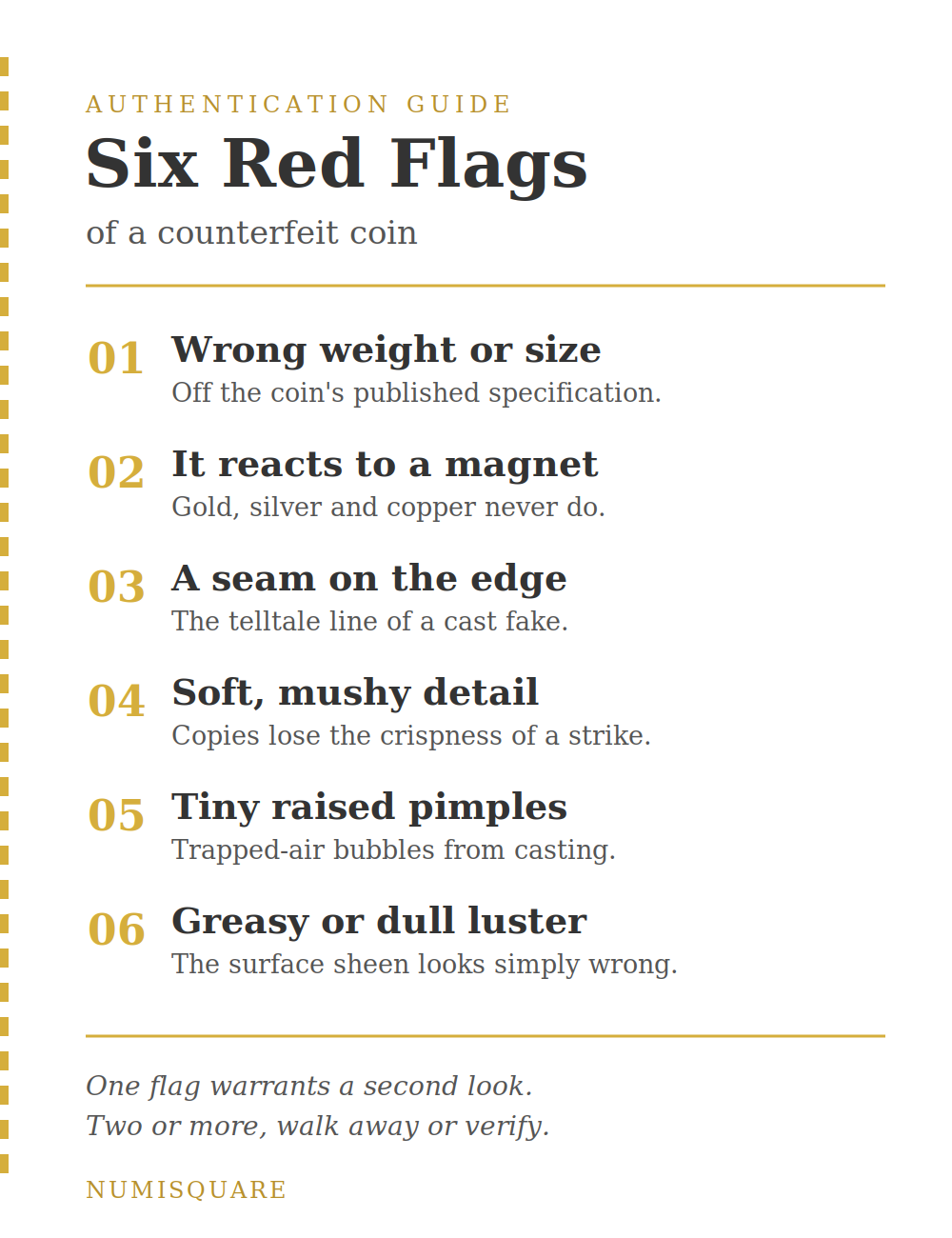
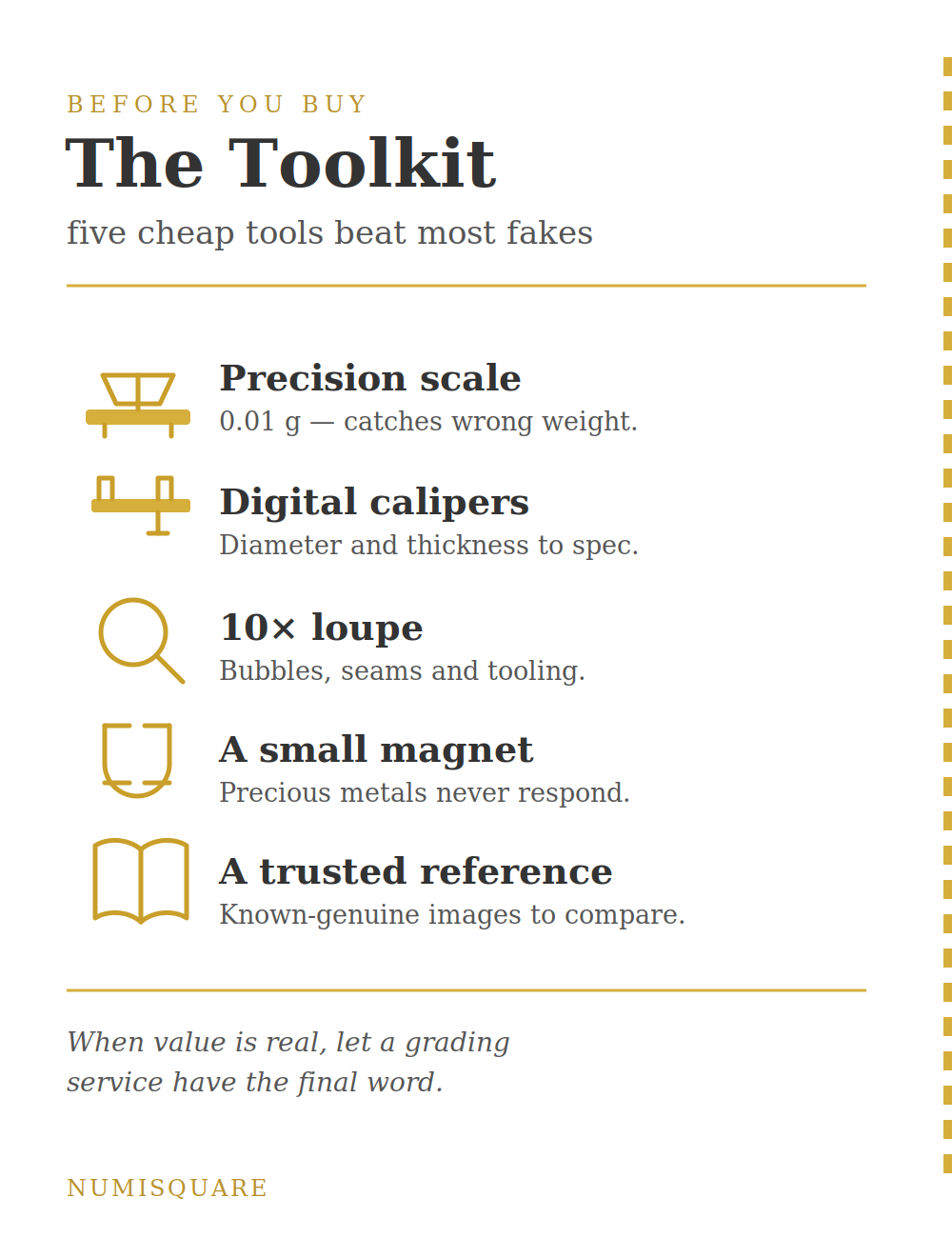
Start with the two measurements that defeat most fakes before you even reach for a loupe: weight and size. Genuine coins were struck to tight, published tolerances, and counterfeiters — especially the makers of cheap cast fakes — routinely miss them. A precise scale that reads to a hundredth of a gram and a set of digital calipers cost very little and catch an enormous share of forgeries. If a coin is meaningfully light, heavy, thick, thin, or wide against its known specification, you have your answer without any further debate.
The magnet test is the next thirty-second check, and it is powerful precisely because it is based on physics rather than opinion. Gold, silver, and copper are not magnetic. If a coin that is supposed to be one of those metals is drawn to a magnet, it has an iron or steel core and is fake. Two honest cautions, though: a few genuine coins are magnetic by design — the U.S. 1943 steel cent being the obvious one — and, conversely, a non-magnetic result does not prove a coin genuine, since better counterfeits use non-magnetic alloys. The magnet condemns; it does not acquit.
Under magnification, the manufacturing method starts to reveal itself. Cast counterfeits are made by pouring metal into a mold taken from a real coin, and the process leaves signatures: a faint seam running around the edge where the mold halves met, and tiny raised pimples on the surface — the fingerprints of air bubbles trapped in the mold. Struck fakes are more dangerous, but they too tend to betray a softness the genuine article never had: mushy lettering, rounded devices, and details that look slightly melted, because a copy die made from a finished coin can never be as sharp as the original. Learn what real mint luster looks like — the cartwheel sheen that rotates across the surface under a light — and a great many fakes will suddenly look greasy, dull, or simply off.
For altered coins, the eye moves to the suspect area itself. An added mintmark, examined at 10x, will often show a difference in surface texture where it was attached, a slightly raised or recessed seat, or tooling marks in the surrounding field that the original die never left. The most heavily faked U.S. rarities — the 1909-S VDB cent, the 1916-D Mercury dime, key-date Morgan dollars — are precisely the coins where a genuine common date wears an added letter, so on those issues the mintmark deserves the hardest look of all.
The history of counterfeiting is, honestly, half the fascination. Some fakes have become so storied that collectors now pursue them on purpose. The "Micro O" Morgan dollars — 1896-O, 1900-O, and 1902-O — were accepted as genuine mint varieties for decades and even certified by grading services, until careful die study proved in 2005 that they were deceptive contemporary counterfeits, struck outside the mint in the early twentieth century from good silver, when a dollar's worth of silver cost far less than a dollar. Then there is the "Omega" man: an anonymous master forger of the 1970s whose fake gold double eagles and three-dollar pieces were so superbly made that his own tiny hidden signature — a minuscule Greek letter omega — became the surest way to identify them. When the counterfeit is better than the collector, the signature is the tell.
None of this should breed fear, only method. Buy the book before the coin: a good reference with genuine images, or a variety guide, turns "something feels wrong" into "the mintmark is the wrong shape." Handle as many authenticated coins as you can, because your eye learns luster and sharpness by seeing the real thing repeatedly. And know the legal backstop — in the United States, the Hobby Protection Act requires that reproductions be plainly stamped COPY, so a piece bearing that word is a replica by law, whatever the seller implies.
Above all, use the ultimate safeguard proportionally. For pocket-change curiosities, your scale, magnet, and loupe are plenty. But when real money is on the line — a four-figure key date, a gold coin, anything whose value would sting to lose — let a reputable third-party grading service render the verdict. Their authenticators have seen every fake in this article and thousands more, and a coin sealed in a genuine grading holder is the closest the hobby comes to certainty. Spotting counterfeits is not about distrust; it is about knowing your coins so well that the fakes have nowhere left to hide.